WORLDS NEAR AND BEYOND
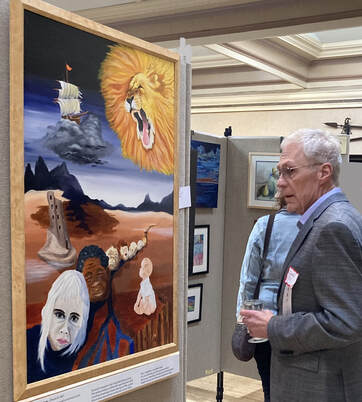
I believe much of what art lovers seek is beauty, a touch of mystery, unique presentation and concept, and the philosophical introspection they experience with each piece they behold. I hope that my portrayals of actual worlds to explore, imaginary worlds to live in vicariously, and philosophical worlds of the mind, intrigue my audience by accomplishing these things.
The literature that accompanies all of my works varies in its seriousness. Some of it is light-hearted or whimsical, where some of it is philosophically earnest and represents a major part of the painting/literature pairing. The latter may be found in my paintings of Philosophical Surrealism, which represent the main focus of my endeavors.
I believe much of what art lovers seek is beauty, a touch of mystery, unique presentation and concept, and the philosophical introspection they experience with each piece they behold. I hope that my portrayals of actual worlds to explore, imaginary worlds to live in vicariously, and philosophical worlds of the mind, intrigue my audience by accomplishing these things.
The literature that accompanies all of my works varies in its seriousness. Some of it is light-hearted or whimsical, where some of it is philosophically earnest and represents a major part of the painting/literature pairing. The latter may be found in my paintings of Philosophical Surrealism, which represent the main focus of my endeavors.
About the Artist
I have painted a variety of styles using acrylic and oil paints, but my true passion has been surrealism, especially that which I have developed as Philosophical Surrealism. All of my paintings are accompanied by poetic or philosophical literature, which enhances the impact of the paintings, but my literature accompanying the Philosophical Surrealism represents my greatest effort.
Surrealistic paintings might seem to be random collages of images, but actually they can be some of the most difficult paintings to plan and develop. I usually begin with a philosophical musing. Sometimes these musings may be simple, and other times they are products of extensive thought and substance.
Either way, I try to imbue the paintings with a touch of mystery, while conveying a thought that is socially or philosophically engrossing.
Historians say that Vincent van Gogh frantically painted up to three paintings in a day. In this light, I am a very slow painter. I often spend nearly as much time to plan a piece as I do to paint it. The combined effort usually takes a few weeks. Of course, van Gogh painted impressionistically, a style focused on the play of light during the instance the artist makes the painting. Artists who employ realism, surrealism, and other such styles of painting often take weeks or months as do I.
Generating ideas for paintings is not a problem for me. I usually have several partially or fully planned, and awaiting my brush. This pause between the plan and the painting is valuable, because it gives me time to reassess the composition before its execution.
I have not persistently marketed myself as an artist, nor have I made a concerted effort to sell my paintings. This, however, should not be interpreted as a lack of seriousness on my part. I apply much thought into what I create.
I have entered my paintings in shows over the years and I have won awards, but what means the most to me is the appreciation that my friends and acquaintances as well as my unseen fans express for my work. I thank everyone for this support. It is what keeps me going. -Dennis
I have painted a variety of styles using acrylic and oil paints, but my true passion has been surrealism, especially that which I have developed as Philosophical Surrealism. All of my paintings are accompanied by poetic or philosophical literature, which enhances the impact of the paintings, but my literature accompanying the Philosophical Surrealism represents my greatest effort.
Surrealistic paintings might seem to be random collages of images, but actually they can be some of the most difficult paintings to plan and develop. I usually begin with a philosophical musing. Sometimes these musings may be simple, and other times they are products of extensive thought and substance.
Either way, I try to imbue the paintings with a touch of mystery, while conveying a thought that is socially or philosophically engrossing.
Historians say that Vincent van Gogh frantically painted up to three paintings in a day. In this light, I am a very slow painter. I often spend nearly as much time to plan a piece as I do to paint it. The combined effort usually takes a few weeks. Of course, van Gogh painted impressionistically, a style focused on the play of light during the instance the artist makes the painting. Artists who employ realism, surrealism, and other such styles of painting often take weeks or months as do I.
Generating ideas for paintings is not a problem for me. I usually have several partially or fully planned, and awaiting my brush. This pause between the plan and the painting is valuable, because it gives me time to reassess the composition before its execution.
I have not persistently marketed myself as an artist, nor have I made a concerted effort to sell my paintings. This, however, should not be interpreted as a lack of seriousness on my part. I apply much thought into what I create.
I have entered my paintings in shows over the years and I have won awards, but what means the most to me is the appreciation that my friends and acquaintances as well as my unseen fans express for my work. I thank everyone for this support. It is what keeps me going. -Dennis